Common Name: Peperomia
Scientific Name: Peperomia
Family: Piperaceae
Origin: tropical and subtropical regions worldwide, in habitats varying from high-altitude cloud forest to near-desert conditions
Leaves:
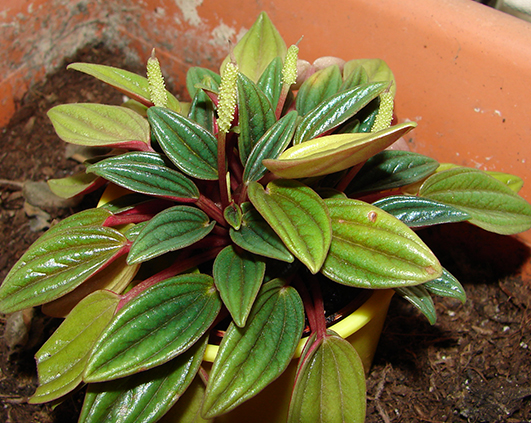
fleshy, often long-stalked, elliptic to ovate or heart-shaped, usually alternate, sometimes in whorls or panicles
Flowers:
small, white or greenish white flowers are produced in upright, sometimes branched and panicle-like spikes; flowering is erratic but mainly in late summer
Light:
semi shade, bright indirect light when in active growth, and in full light in winter
Soil:
loam-based potting compost
Fertilizer:
from spring to summer apply a balanced liquid fertilizer monthly
Air humidity:
maintain moderate to high humidity from spring to summer, mist twice daily
Watering:
moderately in summer, sparingly in winter, preferably with tepid, soft water
Transplanting:
right away after you bought it, than every spring
Dimensions:
25 cm high and wide
Propagation:
sow seed at 19-24 degrees Celsius (66-75 F) when ripe; during growth take softwood, leaf or leaf bud cuttings, or remove offsets of rosetted variants
Life:
1-4 years indoor
Pests and diseases:
trouble free
Species and varieties:

P. argyreia, P. caperata, P. clusiifolia, P. dolabriformis, P. fraseri, P. glabella, P. griseoargentea, P. hederifolia, P. incana, P. maculosa, P. magnoliifolia, P. marmorata, P. matallica, P. nivalis, P. nummulariifolia, P. orba, P. resediflora, P. rotundifolia, P. rubella, P. sandersii, P. scanders, P. velutina, P. verschaffeltii, P. verticillata

Tips:
in frost-pone areas, grow in a warm greenhouse or as houseplants; grow trailing species in a bottle garden; in tropical areas grow as ground cover or in a border
Hardness:
frost tender
(C) 2006 Green Zone Life


Photo by pris.sears

Red Edge Peperomia

Photo by pris.sears

Emerald ripple Peperomia

Photo by pris.sears

Watermelon Peperomia