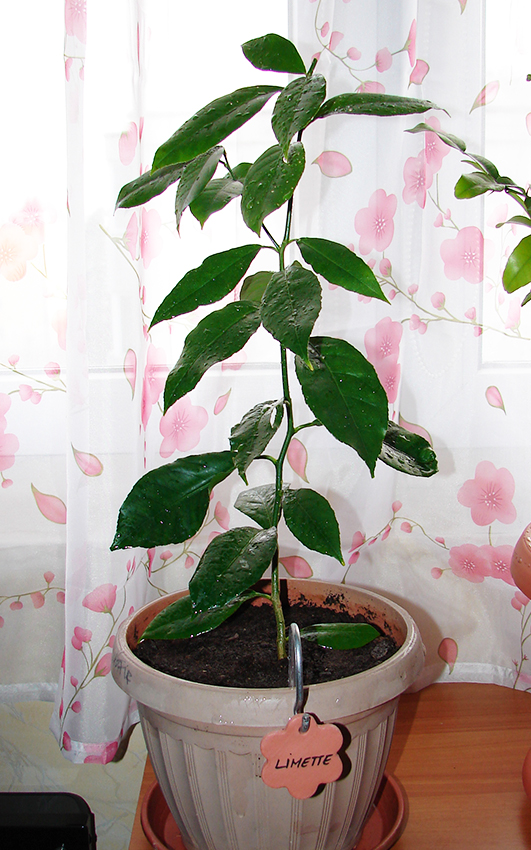
Lime (Citrus aurantifolia) is a small, evergreen, spiny and irregularly branched shrub or tree. It is grown for its small, edible fruits, which are used as flavoring in beverages and as an ingredient in desserts. The bright green fruits are smaller than the lemons, more globular, more acid, with a distinctive flavor and with a thinner rind. The pulp is greenish and in sections of about ten. Limes are gathered when fully grown, but still green, even they are ripening to yellow.
Its leaves are small, elliptic to oblong, leathery, pale green. The white flowers are small, fragrant and produced in axillary's clusters. They are produced from spring to summer. Fruits ripen about 5-6 months following flowering. Lime is more cold sensitive than most of its Citrus relatives and tends to be injured or killed by temperatures below 0 Celsius degrees (32 F).

Grow Lime tree in a place with full sun or in a greenhouse or conservatory if you live in a colder area because it needs heat in order to set quality fruits. It grows and adapts fairly well to sandy soils. Always keep the tree well drained, because extensive periods of flooding or overwatering can lead to rot and kill the tree.
Propagate Lime tree by sowing seeds. It is best to sow seeds that are fresh harvested, but you can also successfully germinate dried seeds if you can maintain a constant soil temperature of 24-30 Celsius degrees (75-85 F). Water seeds moderately, only when the soil surface begins to dry. Sprout in shade, greenhouse or filtered sun. Propagation of Lime trees can also be done by grafting. By using this method trees tend to produce fruits few years faster.